.png)








Nearshore vs Offshore Outsourcing: A Strategic Guide for Leaders Expanding into Asia
Published date: June 29, 2026
5 minutes read
Nearshore vs offshore outsourcing
For organisations considering an outsourcing move, the choice between nearshore and offshore will shape how they hire, where they build capability, and what their workforce looks like over the next decade. Both models extend access to talent beyond the home market. But they suit different priorities and perform differently depending on the roles being hired and the markets being considered.
What is nearshore outsourcing?
Nearshore outsourcing is hiring talent or building teams in a country geographically close to the home market, typically within the same or a similar time zone. The defining advantage is proximity. Time zone alignment makes day-to-day collaboration with onshore hiring managers and business stakeholders more straightforward, and cultural and linguistic overlap tends to be stronger than in more distant markets. Nearshore hiring works well when outsourced teams need to operate in close sync with their onshore counterparts, or when roles require regular, direct interaction with home-market leadership.
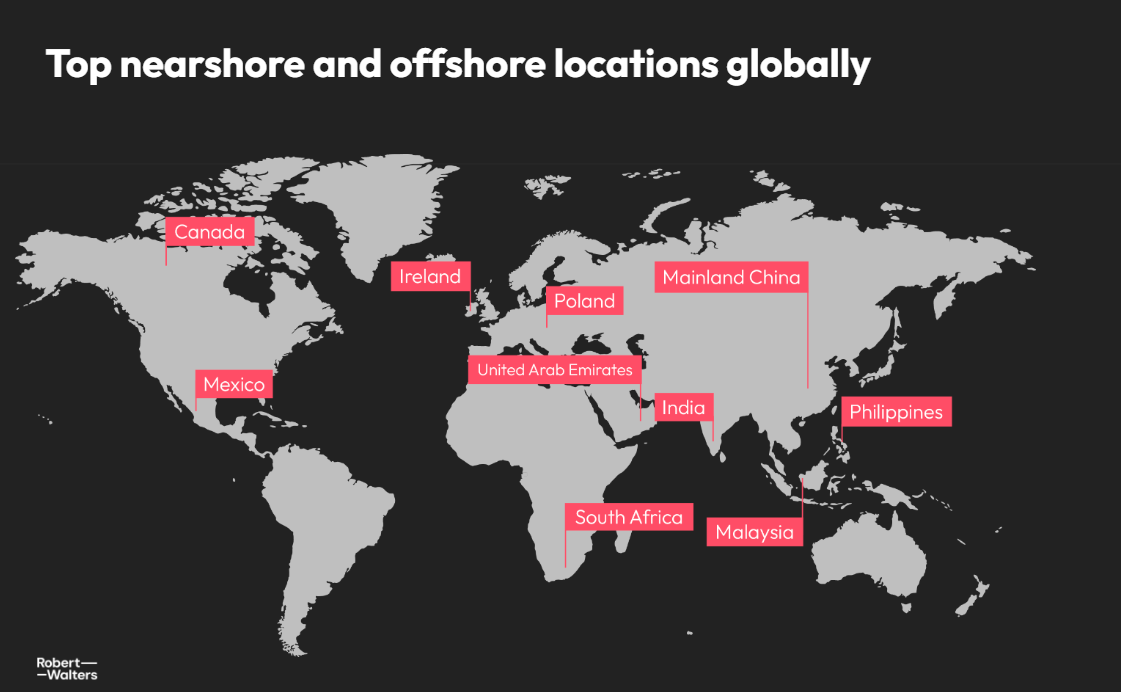
For organisations based in Europe, nearshore destinations most commonly include Central and Eastern European markets such as Ireland and Poland. For US-based organisations, Latin American markets such as Mexico and Colombia are the more common nearshore options. South Africa is also one of the top considerations for specific functions, particularly where English proficiency, cultural alignment, and time zone overlap with Western markets are priorities.
What is offshore outsourcing?
Offshore outsourcing is hiring talent or building teams in countries further from the home market, typically in different time zones and often with a greater salary differential relative to domestic hiring markets.
The most established offshore destinations span multiple regions. In the Middle East, the United Arab Emirates has emerged as a hub for technology and digital talent. In Asia, India, the Philippines, and Malaysia remain the most sought-after markets for organisations building offshore capability at scale, each offering distinct strengths depending on the functions being hired and the scale required.
- India has built deep talent pools across technology, analytics, finance, and business support.
- The Philippines is well established for customer operations, shared services, and back-office support.
- Malaysia offers multilingual capability, strong finance and accounting talent, and growing relevance for regional APAC support functions.
The trade-off with offshore outsourcing is coordination. Time zone gaps require more structured communication, onboarding, and stakeholder management. The point that is most often underestimated, though, is that offshoring is a company-wide undertaking even when only one function moves. The roles that remain onshore change too.
As Tony Cooper, Transformation Advisor at Robert Walters, puts it: "Moving a job is just the start, and the existing workforce you leave behind is just as important as the offshore role you've created." Organisations that succeed offshore plan for both sides of that equation from the outset.
Advantages of nearshore outsourcing
1. Real-time collaboration is the default
Shared or overlapping time zones mean your hiring managers, project leads, and outsourced teams can operate on the same working day. For roles that depend on close interaction with onshore stakeholders, that is structurally easier to deliver nearshore than offshore.
2. Cultural and linguistic proximity
For European organisations hiring in Central or Eastern Europe, or US organisations hiring in Mexico or Canada, cultural alignment with home-market working styles tends to be strong. That reduces onboarding friction and shortens the time it takes new hires to become productive.
3. Easier ongoing visibility
Day-to-day oversight, performance management, and hands-on involvement from onshore leadership are more practical when teams are operating in a similar time window. For organisations building their first outsourced team, that visibility can be valuable while operating models mature.
Disadvantages of nearshore outsourcing
1. Less depth for specialist or large-scale hiring
Nearshore talent markets continue to develop, but they generally do not yet match the breadth of capability available in established Asian markets, particularly for specialist technology, analytics, finance, or regulatory roles at volume.
2. Smaller margin for long-term workforce planning
For organisations planning shared service centres, capability hubs, or large multi-function builds, nearshore markets can hit talent supply ceilings faster than offshore Asia. That can constrain how the model scales over a five to ten year horizon.
3. Employer brand investment is still required
Being well known in your home market does not automatically translate into visibility or appeal in a nearshore location. Organisations hiring in a nearshore location will still need to build a locally credible employee value proposition to compete for the right talent. Without that, even a well-resourced nearshore build can struggle to attract candidates at the quality and volume required.

Advantages of offshore outsourcing
1. Genuine talent depth at scale
India, the Philippines, and Malaysia each offer talent pools that are difficult to match elsewhere, particularly for specialist roles in technology, analytics, finance, and customer operations. For organisations hiring at volume or building specialist capability, that depth is the single biggest advantage of the offshore model.
2. Mature hiring infrastructure
These markets have spent two decades supporting international organisations, which means the recruitment ecosystem, candidate readiness, and delivery experience are well developed. The constraint is usually hiring strategy rather than talent supply.
3. Stronger long-term strategic value
Offshore models, properly built, support sustained workforce growth, capability hub development, and multi-function expansion over time. Clients working with Robert Walters on offshore hiring strategy report up to 81% in operational savings, but the more important outcome is the quality and stability of the talent built over the long term.
4. Multi-market flexibility
Asia is large enough that organisations can spread hiring across several markets, using each for the functions it is best equipped to support. That flexibility strengthens long-term resilience and reduces concentration risk.
Disadvantages of offshore outsourcing
1. Coordination requires structure
Time zone gaps mean briefing, onboarding, and stakeholder management need to be designed deliberately. Organisations that succeed offshore tend to treat workforce coordination as a core part of the strategy, not an informal arrangement.
2. Retention is the biggest underestimated risk
Across offshore operations, talent-related issues consistently rank as the leading challenge, with employee attrition cited ahead of cost and operational complexity. High attrition erodes delivery long before any financial benefit is realised.
3. Employer brand needs to be built locally
A brand that is well known onshore often has limited visibility in Bengaluru, Manila, or Kuala Lumpur. Without a locally credible employee value proposition, attracting and keeping the right people becomes significantly harder.
4. Onshore roles change too
Offshoring is a company-wide undertaking even when only one function moves. The roles that remain onshore evolve, and organisations that plan for both sides of that equation from the start get better results from the offshore build.
Why Asia stands out as an offshore destination
The map of viable offshore and nearshore locations is wider than it has ever been, spanning markets as varied as Poland, Ireland, Mexico, South Africa, and the UAE. So why does the offshore conversation keep returning to Asia?
The answer is depth and maturity. No other region combines talent volume, hiring infrastructure, and proven experience to the same degree. India, the Philippines, and Malaysia have each spent two decades supporting international organisations, meaning the talent pools are not only large but practiced in working to global standards and expectations.
That maturity changes what is possible. In less established markets, the limiting factor is usually talent supply. In the major Asian markets, the constraint is more often hiring strategy: knowing which roles to prioritise, how to position against local competitors, and how to retain people once hired. That is a more solvable problem, and a better one to have.
It also makes a multi-market approach realistic, with organisations spreading hiring across several locations and using each for the work it is best equipped to support. For organisations taking a long-term view of their workforce, that combination of scale, maturity, and flexibility is what sets Asia apart.
What leaders should address before deciding
The most common mistake organisations make is leading with location rather than with workforce strategy. Where to hire is a downstream decision. A small number of questions tend to shape long-term hiring success more than anything else:
- Which functions are you moving offshore or nearshore, and at what level of complexity?
- Which roles require specialist expertise, and which require volume hiring?
- What do salary benchmarks, attrition trends, and talent supply look like in your target markets?
- How will your onshore hiring managers work effectively alongside offshore teams?
- What hiring model will you need to build at the required pace and quality: Full RPO, Project RPO, or dedicated offshoring talent support?
These decisions become particularly important when the offshore build forms part of a larger shared service centre or global capability centre strategy, where hiring volumes, role complexity, and long-term workforce design all need to be aligned from the outset.
Building offshore capability that lasts
Nearshore and offshore outsourcing are not competing strategies. They are different tools that suit different hiring challenges. The organizations seeing the strongest results start with a clear view of the talent they need, the markets best placed to supply it, and a realistic plan for hiring at pace without sacrificing quality.
Speed and structure can coexist. In one recent build, our team established fully operational Project RPO solutions in the Philippines within four weeks, filling 150 specialist roles in the first five months at a 70% interview-to-offer conversion rate. That pace was possible precisely because the talent strategy, hiring model, and local market knowledge were in place before recruitment began.
If you are exploring offshore hiring in India, the Philippines, Malaysia, or elsewhere in Asia, our offshoring talent specialists can help you assess the talent landscape and shape a hiring approach that supports your long-term plans. Download our Offshoring Talent Solutions e-guide or speak with our team about your specific requirements.
Exploring offshoring with a partner?
-
What is the difference between nearshore and offshore outsourcing?
Nearshore outsourcing involves hiring talent in countries geographically close to the home market, usually within a similar time zone. Offshore outsourcing involves hiring in more distant markets such as India, the Philippines, or Malaysia. The biggest differences are typically time zone alignment, collaboration models, talent depth, scalability, and cost structures. Nearshore outsourcing often supports closer operational collaboration, while offshore outsourcing is commonly used for larger-scale hiring and specialist capability. -
Why are organisations choosing Asia for offshore outsourcing?
Asia offers significant talent depth across technology, finance, analytics, customer operations, and shared services. Markets such as India, the Philippines, and Malaysia also have mature hiring infrastructure and extensive experience supporting international organisations. For many businesses, Asia provides a combination of scalability, specialist capability, and operational efficiency that is difficult to replicate elsewhere. -
Which is better for specialist hiring: nearshore or offshore outsourcing?
The answer depends on the functions being hired and the scale required. Nearshore outsourcing can work well for highly collaborative teams operating closely with onshore stakeholders. However, offshore markets in Asia generally offer deeper specialist talent pools across technology, finance, analytics, and operations, particularly for organisations hiring at scale. -
How long does it take to build an offshore team in Asia?
Timelines vary depending on the scope of the build, the locations involved, and the complexity of the roles being hired. With the right hiring partner in place, capability can be deployed at an offshore location within six weeks or less, giving organisations a fast and structured start to their build. Organisations that invest in market intelligence and specialist hiring support early in the process consistently reach operational readiness faster and with fewer avoidable setbacks along the way. -
What is the difference between offshore outsourcing and a global capability centre?
Offshore outsourcing is a broad term covering any arrangement where talent is hired or teams are built outside the home market, including third-party managed models. A global capability centre (GCC) is a specific organisational structure within that broader category, one where the business retains direct ownership and control over the offshore team, its hiring, and its long-term development. GCCs typically involve greater internal investment and a more structured approach to talent planning and capability building over time. The decision between a GCC and other offshore models usually comes down to how much direct control over hiring and workforce strategy the organisation wants to retain, and at what scale the offshore operation is intended to run.
Related content
View All
What Is A Global Capability Centre (GCC)?
A guide to global capability centres (GCCs) For banking, insurance, and financial services firms, growth is increasingly shaped by access to talent. As hiring pressure rises across operations, technology, compliance, analytics, and customer support, many organisations are rethinking how and where th
Read More
What Is A Shared Service Centre? A Guide For Leaders
What is a shared service centre? A shared service centre (SSC) is a centralised business unit that delivers common operational functions, such as finance, HR, IT, compliance, and customer operations, across multiple parts of an organisation. Rather than duplicating these activities in every market o
Read More
Why Do Companies Choose to Outsource Work?
As organisations face increasing pressure to control costs, adapt quickly to change, and access specialist expertise, many are rethinking how work is delivered. Rather than managing every function internally, companies are turning to outsourcing as a strategic solution to improve efficiency and perf
Read More