.png)








How TA Can Work Better Across Functions in Banking and Insurance
For banks and insurers, hiring decisions increasingly reach beyond talent acquisition. A role may need budget approval from finance, technical input from technology, supplier support from procurement and a view on whether the capability should be hired, developed internally or sourced another way. TA still owns recruitment delivery, but it can add more value when market insight is brought into those wider decisions before a role reaches the market.
Why hiring decisions now cut across more functions
Regulatory change, technology programmes and cost pressure are shaping workforce demand across banking and insurance.
Technology may define the capability. Finance may determine where headcount can sit. Procurement may oversee the contingent labour or supplier arrangements. TA brings the external market perspective: how limited the talent pool is for the required skill, candidate expectations and the realistic timeline when a role can be hired.
Problems can arise when those decisions happen separately. A role may be scoped before the budget is clear, or a supplier strategy agreed without a full view of the talent market. The opportunity is not necessarily to restructure these functions, but to help them share information earlier.
Where the disconnect can show up in banking
With TA’s newly mandated responsibility in mind, the function is at a crossroads with very different futures - a function that empowers business agility while gatekeeping quality and compliance, or one that simply exists to rubber-stamp without added direction or value.
The misalignment between TA and adjacent functions tends to surface in a small number of recurring patterns.
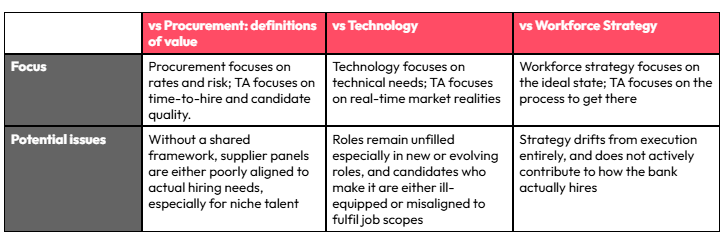
The banks managing this best are not necessarily restructuring their organisations or compromising on each function’s specific considerations. In most cases, they are building better operating rhythms between functions that already exist.
Where the disconnect can show up in insurance
Compared to their banking counterparts, the insurance industry faces many of the same structural tensions, but the nature of the talent market and the shape of the business create some distinct friction points of their own.
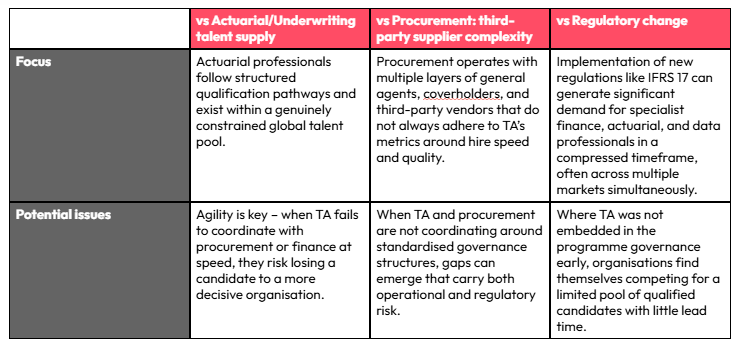
What this means for TA leaders
A cross-functional model does not require TA to own every workforce decision. It does require the function to understand enough about the wider business to contribute before those decisions are fixed.
As Kristian Warner, Head of Recruitment, APAC and Head of Global Recruitment Operations at GSK, puts it in our TA evolution e-guide: “The recruiter role has become less transactional and more strategic.”
That shift asks more of TA leaders. Market knowledge remains important, but so does the ability to understand business priorities, challenge assumptions constructively and explain what talent conditions mean for cost, timing and delivery.
Dionne Atwill, Founder & CEO of ExecTASocial, makes a similar point: “If you want to be a strategic partner, you have to understand the business inside out – not just TA. That means knowing the numbers, the market, and the levers that drive growth.”
For some organisations, internal teams will have the capacity to build this way of working themselves. Others may need additional delivery support while TA leaders spend more time with finance, procurement, technology and programme teams. An RPO or Project RPO model can provide that extra capacity while keeping internal TA leadership close to the decisions that matter.
Including the right teams into the conversation earlier
A useful starting point is to look at a small number of critical or recurring roles and ask where decisions tend to slow down. Was the role fully scoped before TA saw it? Was budget agreed? Were supplier or location options considered early enough?
Those questions can reveal where a different operating rhythm would help, without adding unnecessary governance.
If you’re reviewing how talent acquisition connects with the functions that shape workforce decisions in your organisation, speak with our talent solutions experts. We can explore where stronger coordination or additional delivery support could make sense for your business.
Meet our expert RPO team

Jenny Fulton
Managing Director APAC - Outsourcing, Robert Walters
Jenny leads Robert Walters' most strategic client partnerships across APAC, bringing deep regional expertise to help organisations navigate talent opportunities across mature and emerging markets.

Charlie O'Farrell
Head of Growth, APAC
Charlie drives growth initiatives across APAC, leveraging over 15 years of experience in operations and growth to deliver strategic, tailored workforce solutions that help clients thrive.
FAQs
-
Why Is Cross-Functional Alignment Particularly Important in Banking and Insurance?
Hiring in banking and insurance often sits at the intersection of regulation, technology, finance and workforce planning. A role may depend on technical sign-off, budget approval, supplier arrangements or specific regulatory requirements before recruitment can move. That makes coordination more important than in environments where hiring decisions are more self-contained. The aim is not to involve every function in every vacancy. It is to make sure the right teams contribute early enough when a role carries wider operational, regulatory or transformation implications. -
Does Improving Cross-Functional Collaboration Mean Restructuring Our Organisation?
Not necessarily. In many cases, the functions already exist and have clear responsibilities. The opportunity is often to improve how and when they share information. That might mean bringing TA and technology together before a specialist role is scoped, or giving finance a more current view of hiring priorities before budget decisions are fixed. Some organisations may choose to change reporting lines, but better collaboration can also come from simpler operating rhythms, clearer accountability and more regular discussion around critical workforce needs. -
How Can an RPO or Project RPO Model Support Cross-Functional Alignment?
An RPO or Project RPO model can provide additional hiring capacity while creating a more consistent point of coordination across the teams involved in recruitment. Depending on the organisation, that may include working with procurement on supplier arrangements, helping business leaders refine role requirements or bringing current market information into workforce discussions. The model should reflect the organisation’s existing structure rather than replace it. For banks and insurers managing complex or fluctuating hiring demand, this can give internal TA leaders more room to focus on stakeholder relationships and workforce planning. -
What Are the Risks When Functions Are Not Well Aligned Around Hiring?
The effects can show up in several ways. Roles may reach the market before budgets are confirmed, specifications may not reflect current talent availability, or supplier arrangements may not suit the skills being hired. That can slow recruitment and create extra work for the teams involved. Over time, it can also make workforce plans harder to deliver. These issues do not necessarily point to a problem with TA itself. They may simply show that the functions shaping a hiring decision need better visibility of one another’s priorities earlier in the process. -
Where Should an Organisation Start if It Wants to Improve Cross-Functional Collaboration?
A useful place to start is with a small number of critical or recurring roles. Look at where the decision slowed down, which functions were involved and what information arrived too late. Patterns often become visible quickly, such as budget approval following role scoping or technical requirements changing after recruitment has begun. From there, leaders can introduce targeted changes rather than redesigning the whole process. For organisations with significant hiring volume or complexity, an external talent partner can also help identify where additional coordination or delivery support would be useful.
Related content
View All
Embarking on a global expansion strategy is an exciting, yet complex undertaking. While attention often turns to market entry, legal frameworks, and operational logistics, the single most critical factor for success, especially in an offshoring model, is accurately defining and acquiring the right t
Read More
The Singapore job market is bustling now, with a shortage in the talent pool and the majority of companies heavily focused on hiring local talents which means that there is a higher demand across several sectors for experienced Singaporeans professionals. Essentially, there has never been a better t
Read More
Similar to marketers who wish to gain “top of mind awareness” when selling their products and services, many employers now wish to achieve the position – “Employer of Choice”, in order to hire the best candidates. So how do companies go about securing this position amongst the sea of competitors in
Read More